
Video Verification vs. Traditional Alarm Monitoring: What Plano Businesses Should Know
If your commercial alarm system trips at 2 a.m., what actually happens next?

For most businesses in Plano and the DFW Metroplex still relying on traditional alarm monitoring, the answer is less reassuring than it should be. A sensor triggers. The monitoring center calls you or a key holder. Someone decides whether to call the police. The police are dispatched as an unverified alarm call. That call goes into the queue behind calls where a threat has already been confirmed.
By the time officers arrive, a break-in may be over. Evidence may be disturbed. A theft may be complete.
This is not a hypothetical scenario. It reflects how traditional alarm systems operate by design, and it is why video verification has fundamentally changed the conversation about what commercial alarm monitoring should deliver for businesses in Plano, TX.
Key Takeaways
Traditional alarm systems have false alarm rates that consistently exceed 90% of total activations
Police departments across DFW and Texas deprioritize unverified alarm calls due to high false alarm volume
Video verified alarms confirm a real threat before dispatching law enforcement, resulting in priority response
Video verification also enables live operators to actively monitor and speak directly to intruders on-site
Businesses that switch to video verified monitoring report significant reductions in false dispatches and faster police response
For Plano businesses, the choice between traditional and video verified monitoring directly affects the speed and quality of law enforcement response to real incidents
Table of Contents
How Traditional Alarm Monitoring Works
Traditional commercial alarm systems operate on a straightforward model. A sensor detects an event, whether it is a door contact, motion detector, or glass break sensor. The control panel registers the alarm. The monitoring center receives the signal and calls a designated contact to determine whether the alarm is real. If no one answers or the contact requests a dispatch, police are called as an unverified alarm.
This model was the industry standard for decades, and it still provides a meaningful layer of protection. But it has a structural limitation that becomes critical in high-stakes situations: no one in the response chain actually knows whether a threat is real until someone physically arrives at the location.
The False Alarm Problem in DFW
The structural weakness of traditional alarms becomes clear in the data. False alarm rates for traditional commercial alarm systems consistently exceed 90% of total activations across the industry. This is not a failure of any particular brand or installation. It is a reflection of how motion sensors, door contacts, and environmental factors interact in real commercial environments.
HVAC airflow triggering motion detectors. Employees entering before disarming the system. Animals. Contractor activity. Power fluctuations. All of these generate alarm signals that look identical to an actual intrusion event at the monitoring center.
Police departments across Texas and the DFW Metroplex have responded to this reality by deprioritizing unverified alarm calls. When a department receives hundreds of unverified alarm dispatches and the overwhelming majority turn out to be false, verified response becomes the standard by which calls are prioritized. An unverified alarm call goes into a lower-priority queue than a call where someone can confirm a threat is actually occurring.
For a Plano business owner, this means the response time to a real event under traditional monitoring may be significantly longer than expected.
How Video Verification Changes the Response
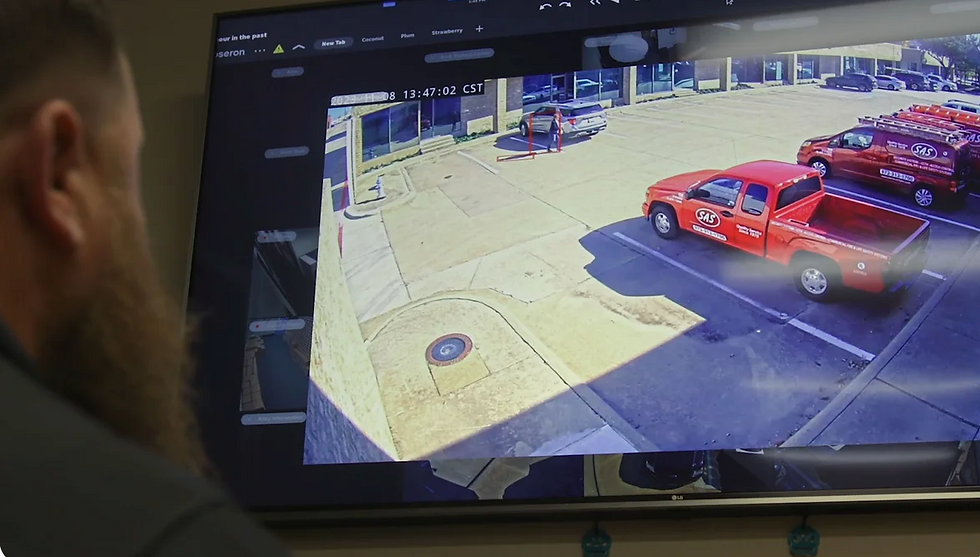
Video verified alarm monitoring adds a visual confirmation step to the response chain. When an alarm triggers, instead of automatically dispatching or calling a key holder, the monitoring center immediately accesses live camera footage at the site.
A trained operator reviews the footage in real time. They determine whether the event is a genuine threat, a false alarm, or something that requires a non-emergency response. If they confirm a real threat, they contact police with verified information: active intrusion in progress, number of individuals, their location within the property, and a real-time description.
According to research referenced by security industry analysts, false alarm rates drop dramatically when video verification is used, and police treat verified calls as priority dispatches rather than routine unverified alarm calls. The result is a faster, better-informed law enforcement response when it actually matters.
Video verification also enables monitoring operators to use on-site speakers to address intruders directly, frequently deterring the incident before it escalates further.
Head-to-Head Comparison: Traditional vs. Video Verified
Factor | Traditional Alarm Monitoring | Video Verified Monitoring |
False alarm rate | Consistently above 90% | Dramatically reduced through visual confirmation |
Police response priority | Lower priority (unverified call) | Higher priority (confirmed active threat) |
Response chain | Sensor triggers → call key holder → dispatch | Sensor triggers → live video review → verified dispatch |
Operator awareness | Signal data only | Live visual of the event |
Deterrence capability | Alarm sound only | Live voice-down to intruders on-site |
Evidence quality | Alarm log | Video footage of active event |
Response speed to real events | Delayed by verification steps | Faster due to priority dispatch |
Cost | Lower monthly cost | Higher monthly cost, significantly higher value per real event |
What Happens During a Video Verified Alarm Event
To understand why video verification matters for Plano businesses, it helps to walk through how an actual event unfolds.
Step 1 — Alarm triggers. A sensor detects a door contact opening or motion in a zone after hours.
Step 2 — Operator accesses live video. Within seconds, a trained monitoring operator views live footage of the triggered zone. They can see exactly what is happening in real time.
Step 3 — Threat is assessed. If the operator confirms an intrusion, they proceed. If it is clearly a false alarm (a cleaning crew entering or a stray animal triggering a sensor), no dispatch is made.
Step 4 — Voice-down deterrence. The operator may activate on-site audio to address the intruder directly, announcing that authorities have been contacted and they are being recorded. This step alone resolves many events before police arrive.
Step 5 — Verified dispatch. Police are contacted with confirmed, specific information. The call is treated as a priority verified alarm rather than an unverified signal.
Step 6 — Evidence is preserved. Live and recorded footage is available to law enforcement immediately upon arrival. The entire event is documented from first trigger through police contact.
Remote video monitoring is the operational model that makes this possible, and SAS Security deploys it across commercial properties throughout Plano and the DFW Metroplex.
Is your current alarm monitoring delivering verified responses or just signals? Contact SAS Security to learn about video verified monitoring for your Plano business. Call 972.312.1700.
Who Benefits Most from Video Verification in Plano
While video verification improves outcomes for any commercial property, certain business types in Plano see the most significant benefit.
Retail and Restaurant Businesses
High after-hours risk combined with a history of traditional alarm false dispatches (cleaning crews, early deliveries, employee returns) makes video verification especially valuable. A monitoring operator who can see whether the person in your restaurant at 1 a.m. is a burglar or your closing manager eliminates the false dispatch entirely.
Warehouses and Industrial Properties
Large open facilities with multiple entry points and significant inventory value are strong candidates for video verification. The ability to confirm an active intrusion in a warehouse before police are dispatched is the difference between apprehension and a clean getaway.
Multi-Tenant Commercial Buildings
With multiple authorized tenants and varied schedules, traditional alarm systems in multi-tenant buildings along Plano's Legacy corridor and downtown generate frequent false dispatches due to after-hours tenant activity. Video verification contextualizes every event before a dispatch decision is made.
Remote Video Monitoring as an Extension of Video Verification
Video verification is the verification step within an alarm monitoring response. Remote video monitoring takes the concept further by actively watching your property rather than waiting for an alarm to trigger.
With remote video monitoring, trained operators are actively reviewing camera feeds from your Plano property throughout coverage hours. Suspicious behavior can be identified and addressed before a sensor is ever triggered. This proactive model fundamentally changes the security posture from reactive to preventive.
For businesses where after-hours risk is high, including auto dealers, construction staging areas, outdoor storage facilities, and retail centers in Plano, remote video monitoring provides a level of active protection that traditional alarm systems cannot match.
FAQs
What is video verified alarm monitoring?
Video verified monitoring adds a live video review step before law enforcement is dispatched. When an alarm triggers, a monitoring operator views live camera footage to confirm whether a real threat is occurring before contacting police.
Why do police deprioritize traditional alarm calls?
Traditional alarm systems generate false alarm rates exceeding 90% of total activations. Police departments across DFW respond to this by treating unverified alarm calls as lower-priority dispatches compared to calls where a real threat has been confirmed.
How much faster is police response to a verified alarm?
While specific response times vary by jurisdiction and availability, verified alarm calls receive priority dispatch treatment versus standard queuing for unverified alarms. The difference can be significant during high-call-volume periods.
Does video verification require cameras I do not already have?
In many cases, existing commercial cameras can be integrated into a video verified monitoring setup depending on their resolution and connectivity. A site assessment by SAS Security determines whether existing equipment is suitable or upgrades are needed.
What is a voice-down in video monitoring?
A voice-down is when a monitoring operator uses on-site speakers to speak directly to an intruder, announcing that they are being recorded and that authorities have been contacted. Voice-downs frequently deter incidents before police arrive.
Is video verified monitoring more expensive than traditional monitoring?
Monthly costs for video verified monitoring are higher than traditional alarm monitoring. For most Plano businesses, the improvement in response quality and reduction in false dispatch fees offsets the cost difference significantly.
Can video verified monitoring reduce false alarm fines?
Yes. False alarm fines from local jurisdictions are a real cost for businesses relying on traditional alarm systems. Video verification eliminates most false dispatches, directly reducing or eliminating those fines.
Does SAS Security offer video verified monitoring in Plano?
Yes. SAS Security provides professionally monitored commercial alarm systems including video verification services across Plano and the full DFW Metroplex. Contact SAS Security at 972.312.1700 to discuss options for your property.
What is the difference between video verification and remote video monitoring?
Video verification is the step of confirming an alarm event via live footage before dispatching. Remote video monitoring is an active service where operators watch your cameras throughout coverage hours rather than waiting for a sensor to trigger.
How do I know if my current alarm monitoring includes video verification?
Contact your current monitoring provider and ask specifically whether video verification is included in your service. Many traditional monitoring plans do not include it. SAS Security can assess your current setup and recommend upgrades. Call 972.312.1700.
References:


Comments