
Security Camera Placement Guide for Plano and DFW Commercial Properties
Installing security cameras is one thing. Installing them in the right places is something else entirely.

Across Plano and the DFW Metroplex, businesses invest in commercial surveillance systems only to discover after an incident that the angle was wrong, the coverage zone missed the point of entry, or a key area was left completely unmonitored. By that point, the footage that could have identified a suspect, documented a liability claim, or prevented a loss simply does not exist.
Strategic camera placement is what separates a surveillance system that works from one that looks like it works. The difference comes down to understanding which zones carry the highest risk, which camera types serve which coverage needs, and how mounting height, angle, field of view, and lighting conditions interact to produce usable footage when it matters most.
This guide walks Plano and DFW business owners and property managers through the principles and specific placement strategies that produce complete, legally defensible, operationally useful commercial surveillance coverage.
Key Takeaways
Entry and exit points are the single highest-priority placement zone for any commercial property in Plano or DFW
Cameras mounted between 8 and 10 feet provide the optimal balance of facial capture angle and vandal resistance for most commercial interiors
Every commercial property has unique blind spot risks — a professional site assessment identifies them before an incident exposes them
Camera type selection (dome, bullet, PTZ, fisheye) must match the coverage zone — no single camera type covers every need
Texas law prohibits cameras in any space with a reasonable expectation of privacy, regardless of whether it is on commercial property
Proper lighting and camera resolution work together — a high-resolution camera in poor lighting produces poor footage
Table of Contents
Why Camera Placement Matters More Than Camera Brand
A common misconception among Plano and DFW business owners is that camera quality is the primary variable in surveillance system performance. In practice, placement strategy has a greater impact on real-world effectiveness than resolution or brand.
Consider two scenarios. In the first, a business installs high-resolution cameras at the wrong height, pointed at an angle that captures a door frame rather than the face of the person walking through it. In the second, a business installs mid-range cameras at the correct height, angled properly to capture a full facial image of every person entering. Only the second scenario produces footage that law enforcement can use to identify a suspect.
The same logic applies to parking lot coverage, point-of-sale monitoring, inventory zone surveillance, and perimeter coverage across commercial properties throughout Plano, Allen, Frisco, and the broader DFW area.
This is why SAS Security begins every commercial surveillance engagement with a site assessment before recommending any equipment. The property layout, foot traffic patterns, lighting conditions, and threat history of a Plano retail center differ significantly from those of a Legacy West office campus or a medical facility along the US-75 corridor.
The Five Coverage Zones Every Plano Business Must Address
Regardless of industry, size, or building type, every commercial property in Plano and DFW should ensure complete camera coverage across five core zones.
Zone 1: Entry and Exit Points
Every door through which a person can enter or exit the building is the single highest-priority placement location for any commercial surveillance system. This includes primary entrances, secondary and emergency exits, loading dock doors, and any access point used by employees that is not visible from a staffed position.
Cameras at entry points should be positioned to capture a clear facial image of every person entering or exiting. This requires mounting above the door frame, angled slightly downward to capture face level as the person passes through — not pointed directly at the door surface.
Zone 2: Parking Lots and Perimeter
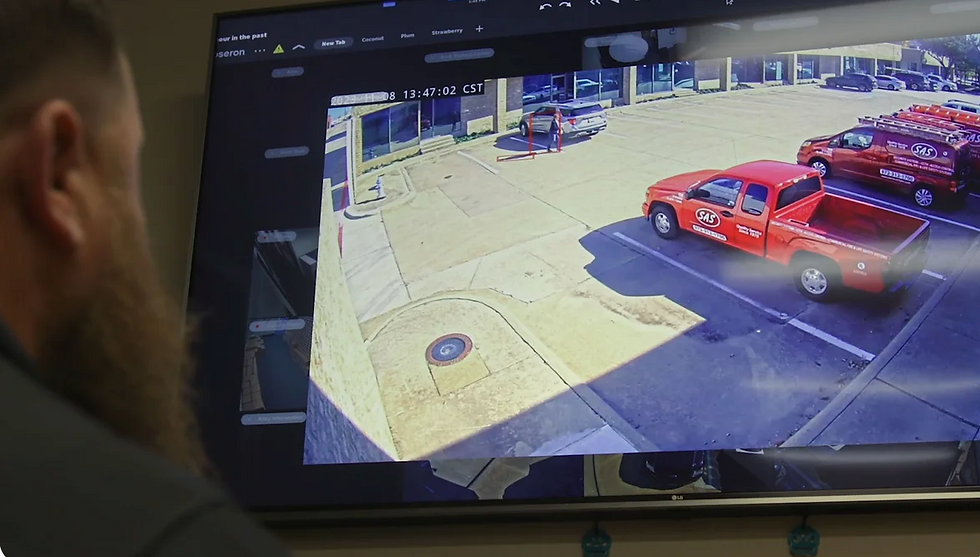
Parking lots are among the most common locations for vehicle break-ins, vandalism, assault, and theft across Plano and DFW commercial properties. Perimeter cameras should provide overlapping coverage with no blind spots along fence lines, property boundaries, and exterior building walls.
Wide-angle cameras mounted at elevated positions on light poles, building corners, or dedicated camera poles provide the broad field of view needed for large parking areas. For multi-level parking structures common in Plano's Legacy and downtown districts, each level and stairwell requires dedicated coverage.
Zone 3: Interior High-Traffic Corridors
Hallways, lobbies, elevator banks, and common areas connect every zone of a building. Cameras in these areas document movement throughout the facility and are often the only way to trace the path of a subject from entry to the point of an incident.
Interior corridor cameras should be positioned to provide continuous visual coverage from one camera to the next, with no gap in the sightline. A subject walking the length of a corridor should remain visible in at least one camera at every point along the route.
Zone 4: Transaction and Asset Zones
For retail businesses, this means point-of-sale counters and cash register areas. For financial offices, it means teller stations and vault access points. For warehouses and distribution facilities, it means receiving docks, inventory storage areas, and high-value product zones.
Cameras in transaction and asset zones should capture both the transaction surface and the face of the person at the counter. Two-angle coverage — one overhead and one at eye level — provides the most complete documentation for liability and theft investigation purposes.
Zone 5: Building Exterior and Approaches
The exterior perimeter of the building — including rooflines, mechanical equipment areas, dumpster enclosures, and utility access points — represents the zone where unauthorized access typically begins before it reaches a monitored interior area. Cameras covering exterior approaches give Plano businesses the earliest possible warning of a developing situation.
Camera Mounting Height and Angle Best Practices
Mounting height is one of the most frequently misapplied variables in commercial camera installation. Two specific errors appear regularly across Plano and DFW commercial properties: cameras mounted too high and cameras mounted with the wrong vertical angle.
Optimal interior mounting height: 8 to 10 feet At this height, cameras capture facial detail at a natural downward angle without being so elevated that face recognition becomes difficult. Cameras mounted above 12 feet typically capture the tops of heads rather than faces, dramatically reducing the investigative value of the footage.
Optimal exterior mounting height: 10 to 14 feet Exterior cameras need additional height to extend the field of view across parking areas and perimeter zones while remaining above the reach of vandals. Higher mounting on light poles or building corners is appropriate for wide-area coverage, but dedicated facial capture cameras at entries should still follow the 8 to 10 foot guideline.
Angle and tilt Cameras should be tilted to center the coverage area in the middle of the frame rather than at the top or bottom edge. A common error is installing cameras pointed slightly upward to capture the ceiling line rather than the activity zone, or tilted so steeply downward that only the immediate floor area is visible.
Overlap between cameras Adjacent cameras should have overlapping fields of view so that a subject moving from one zone to the next is always visible in at least one camera. A minimum of 10 to 15 percent field-of-view overlap between neighboring cameras eliminates the dead zones that investigators encounter when tracing a subject's movement through a facility.
Choosing the Right Camera Type for Each Zone
Camera Type | Best Coverage Zone | Key Advantage |
Dome camera | Interior corridors, lobbies, retail floors | Discreet profile, vandal-resistant housing, wide horizontal coverage |
Bullet camera | Building entrances, parking lot perimeter | Long-range zoom, visible deterrent effect, weatherproof housing |
PTZ (pan-tilt-zoom) | Large open areas, parking lots, warehouse floors | Operator-controlled movement, zoom capability for active monitoring |
Fisheye / 360-degree | Open floor areas, lobbies, intersection points | Single camera covering a full room without blind spots |
Multi-sensor camera | Corner positions, wide-area exterior coverage | Multiple lenses in one housing, broad coverage with single installation point |
License plate recognition | Parking lot entrances and exits | Captures vehicle identification for lot management and incident documentation |
For most Plano commercial properties, a combination of dome cameras for interior zones, bullet cameras for building entries and perimeter, and at least one PTZ for large open areas provides cost-effective complete coverage. SAS Security's commercial video surveillance systems are designed around each property's unique layout rather than a standardized package.
Placement Guide by Business Type
Different business types across Plano and DFW face different risk profiles, and camera placement strategy should reflect those differences.
Retail Businesses Priority zones are entry and exit points, point-of-sale counters, high-value merchandise displays, and stockroom access. A camera covering the full floor from an elevated corner position provides overview coverage. Dedicated close-range cameras at registers capture transaction-level detail. A camera pointed at the parking lot from the storefront covers the approach and vehicle activity.
Office Buildings and Corporate Campuses Priority zones are building lobby entrances, elevator banks, server rooms, executive office suites, and parking structures. Reception area coverage should capture every visitor's face upon entry. Stairwell coverage on each floor provides complete vertical tracking. For multi-tenant buildings in Plano's Legacy and Granite Parkway corridors, dedicated cameras for each tenant suite entrance and shared common areas are standard.
Warehouses and Distribution Facilities Priority zones are receiving docks, inventory storage aisles, product staging areas, and employee entrance points. Overhead fisheye or multi-sensor cameras provide broad coverage across wide open warehouse floors. Dock door cameras capture every truck and driver entering or leaving. A dedicated camera at the employee break room entrance tracks after-hours access to the facility.
Healthcare and Medical Facilities Priority zones are patient reception, waiting areas, pharmacy or medication storage, staff-only zones, and parking areas. Cameras in healthcare environments must be carefully placed to avoid capturing patient care areas in ways that create HIPAA compliance concerns. SAS Security works with Plano medical facility managers to navigate both security coverage and regulatory compliance simultaneously.
Restaurants and Hospitality Priority zones are entrance and exit, POS stations, bar areas, and parking lots. A camera behind the bar from an elevated position captures both the bar surface and the staff operating it. A camera at each register captures customer and cashier interaction. Exterior cameras covering dumpster enclosures and delivery areas address the after-hours risk points most restaurant owners overlook.
Lighting and Image Quality Considerations
Camera resolution means very little without adequate lighting. Across Plano and DFW commercial properties, the most common cause of poor-quality surveillance footage is not camera capability — it is insufficient or poorly positioned lighting in the coverage zone.
Interior lighting: Cameras should not be positioned facing a bright window or light source, as the resulting backlight renders the subject in shadow and produces unusable footage. Position cameras so that the primary light source illuminates the subject from in front of or to the side of the camera, not from behind.
Exterior and parking lot lighting: Cameras in parking lots depend on consistent, even lighting across the coverage area. A single bright light in a dark parking lot creates zones of deep shadow that cameras cannot penetrate. Consult with your security provider about lighting coverage as part of the camera placement plan, not as an afterthought.
Low-light and infrared capability: For areas that cannot be adequately lit, cameras with infrared (IR) or low-light sensors maintain usable image quality in near-darkness. Modern IP cameras with built-in IR illuminators are standard for exterior perimeter coverage across DFW commercial properties.
Camera resolution for facial capture: A minimum of 2MP (1080p) resolution is the current baseline for commercial facial capture at standard mounting heights. For entry points where license plate identification is also required, 4MP or higher resolution combined with proper lighting produces reliable results.
Common Placement Mistakes DFW Businesses Make
Even well-intentioned camera installations regularly contain preventable errors. These are the most common ones SAS Security encounters when assessing existing systems across Plano and DFW commercial properties.
Placement Mistake | Consequence | Correct Approach |
Cameras mounted too high (above 12 feet at entry points) | Captures top of head, not face — footage has no investigative value | Mount entry cameras at 8 to 10 feet, angled to capture face level |
Camera pointed directly at a bright window or light source | Backlight creates a silhouette, rendering the subject unidentifiable | Position cameras so primary light source illuminates the subject |
No overlap between adjacent cameras | Dead zones allow subjects to move untracked through the facility | Plan for 10 to 15 percent field-of-view overlap between neighboring cameras |
Parking lot coverage without dedicated low-light cameras | After-hours footage is unusable in unlighted or poorly lit areas | Use IR or low-light cameras for all exterior coverage zones |
Single wide-angle camera for point-of-sale coverage | Captures the transaction area but misses facial detail | Use a dedicated close-range camera at face level for register areas in addition to overview coverage |
No camera at secondary or emergency exits | Subjects exit without being captured on video | Every door through which a person can exit requires coverage |
Get it right the first time. Contact SAS Security to schedule a professional site assessment for your Plano or DFW commercial property. Call 972.312.1700.
Legal Placement Rules for Texas Commercial Properties
Camera placement in Plano and across Texas must comply with state privacy law. Texas Penal Code Section 21.15 prohibits recording in any location where a person has a reasonable expectation of privacy. For commercial properties, this means cameras are not permitted in restrooms, locker rooms, changing rooms, or any private space regardless of property ownership.
Texas is also a one-party consent state for audio recording under Texas Penal Code Section 16.02. Cameras with audio recording capability must comply with this requirement, meaning at least one party in the recorded conversation must consent to the recording.
Visible "Under Surveillance" signage is not legally required for most Texas commercial camera installations, but it is strongly recommended as a deterrent and as a practical protection against privacy complaints. For a complete review of Texas video surveillance law as it applies to your Plano business, see our detailed guide on Texas video surveillance laws for businesses.
All commercial video surveillance installation in the DFW Metroplex by SAS Security is designed with full compliance with Texas legal requirements.
FAQs
Where should security cameras be placed in a commercial building?
Security cameras should cover all entry and exit points, parking lots, interior corridors, transaction zones like registers and counters, and high-value asset areas. Every door a person can enter or exit through requires a dedicated camera positioned to capture facial detail at 8 to 10 feet mounting height.
What is the best mounting height for commercial security cameras?
For interior commercial cameras capturing facial detail, 8 to 10 feet is the optimal mounting height. Cameras mounted above 12 feet typically capture the tops of heads rather than faces, reducing investigative value. Exterior parking lot cameras can be mounted higher for broader field of view while still maintaining useful resolution.
How many security cameras does a business need?
The number depends on the facility's size, layout, number of entry points, and risk profile. A small retail space may require 4 to 8 cameras while a large warehouse, office campus, or multi-tenant building in Plano may require 20 or more. SAS Security conducts site assessments to determine the correct quantity and placement for each property.
Can I point my business security cameras at public areas in Plano, TX?
Yes. Texas law permits cameras to capture public areas such as sidewalks and streets as an incidental part of monitoring your own property. The primary camera focus should remain on your property. Cameras must not be directed at neighboring private property or spaces where individuals have a reasonable expectation of privacy.
What type of security camera is best for a parking lot in Plano?
Bullet cameras with infrared or low-light capability are the standard choice for Plano parking lot coverage. For large parking areas, PTZ cameras allow monitoring staff to actively zoom and track activity. License plate recognition cameras at entry and exit points add vehicle identification capability for both security and lot management.
Does SAS Security install commercial camera systems in Plano and DFW?
Yes. SAS Security designs and installs commercial video surveillance systems across Plano, Dallas, Fort Worth, Allen, Frisco, and the DFW Metroplex. Every installation begins with a professional site assessment to determine optimal placement before any equipment is specified. Call 972.312.1700 to schedule your assessment.
Camera coverage that works when it matters is a product of strategy, not just equipment. Contact SAS Security for a professional camera placement assessment at your Plano or DFW commercial property. Serving North Texas since 1978.
References
AIS Security: Best Practices for Camera Placement in Offices, Warehouses, and Retail
General Security: Security Camera Installation — The Complete Guide to Perfect Placement
CCTV Security Pros: Security Camera Placement Guide for Homes and Business
Comments